Meet the Team
PIs Seiji Fujimoto (U.Toronto) & Dan Coe (STScI),
with 150+ international members from around the world.
Read more about our team here.


Vast Exploration for Nascent Unexplored Sources
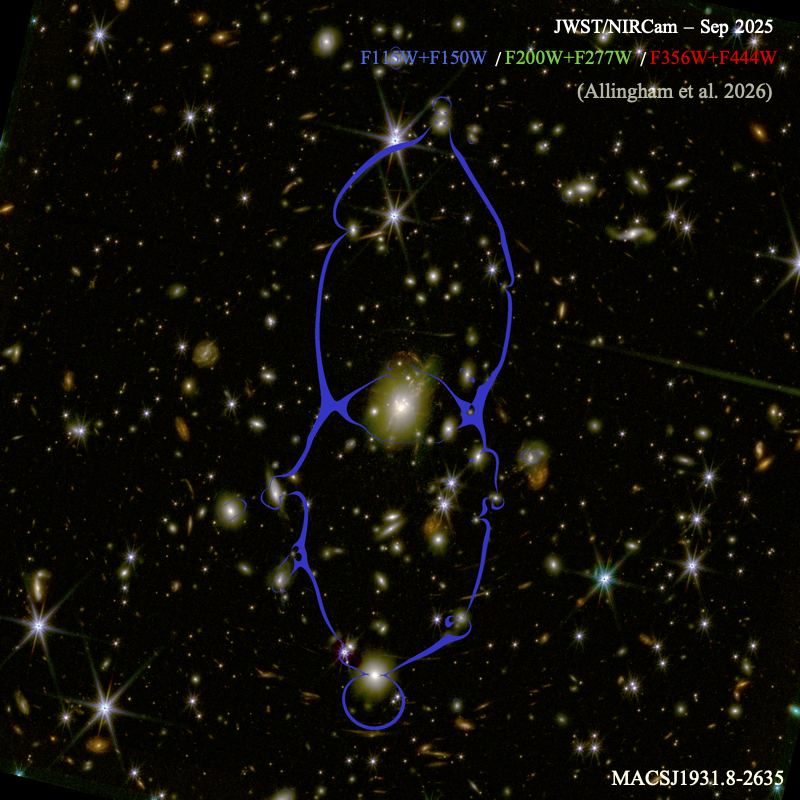
VENUS will unlock uniform 10-filter NIRCam imaging across 60 lensing clusters in Cycle 4
and multi-epoch NIRCam imaging + NIRSpec PRISM+G395M spectroscopy in Cycle 5
Read more about VENUS here.
For team members: Internal website here.

VENUS probes the onset of galaxy formation at z ≳ 14 by identifying and spectroscopically confirming gravitationally lensed, intrinsically ultra-faint galaxies, constraining the UV luminosity function down to MUV ≃ −12 and the role of galaxies in cosmic reionization.

Using strong lensing and high-resolution multi-band NIRCam imaging, VENUS spatially resolves early galaxies down to star-cluster scales (∼1-10 pc), revealing when, where, and how the first stellar populations and proto–globular clusters formed.

VENUS conducts the first systematic census of low-mass black holes in the early universe, measuring black hole masses down to ∼105 M⊙ in lensed galaxies and testing the co-evolution of black holes and their host galaxies at z≃4–10.

By exploiting wide, multi-epoch lensing fields, VENUS opens a new time-domain window on the early universe, enabling the discovery of individual lensed stars and supernovae at z ≳ 5, including rare explosions from massive, low-metallicity stars that directly constrain the high-redshift initial mass function.
Check out our latest updates, breakthroughs, and project milestones.
See all press releases and milestones here.
Loading updates...
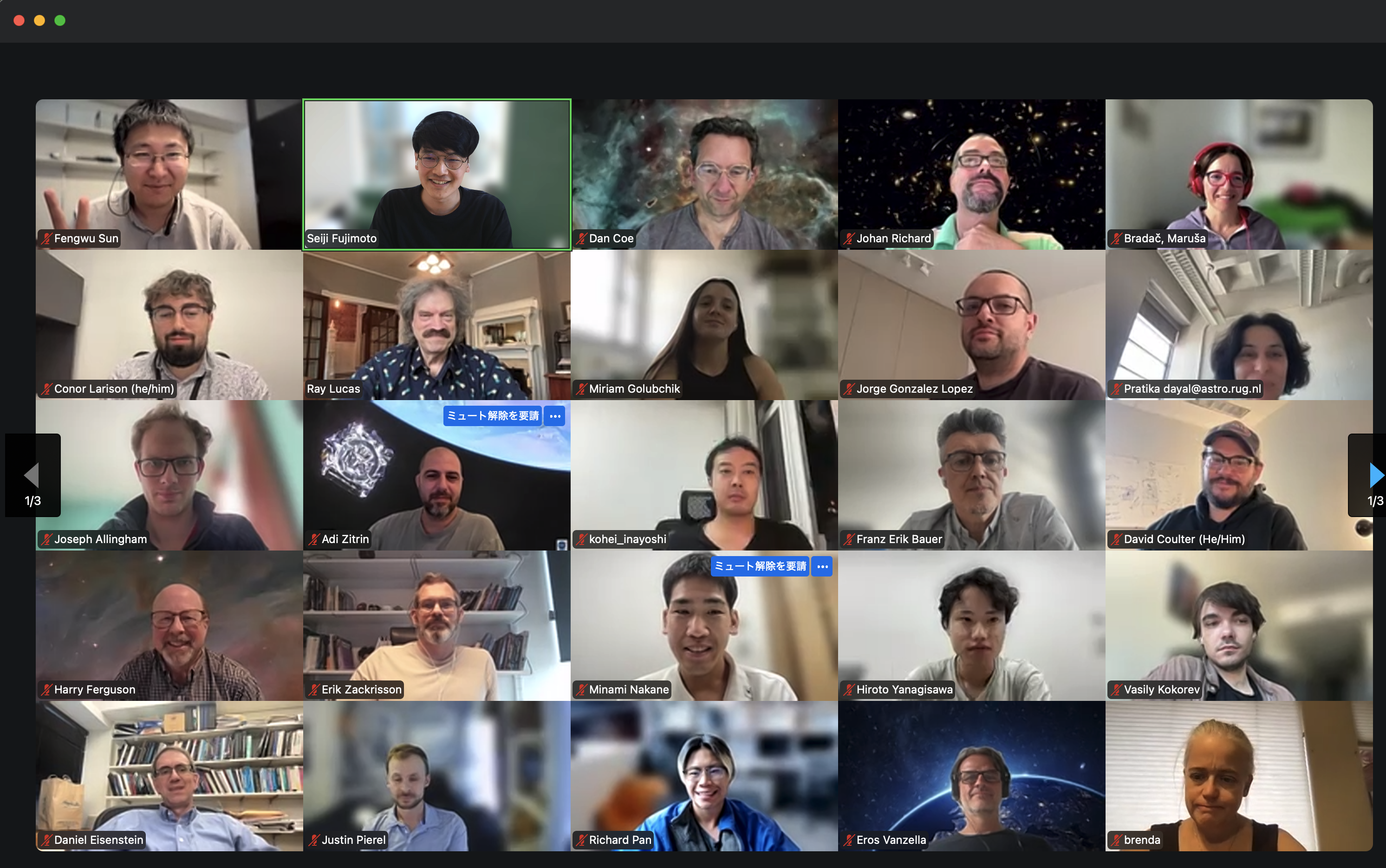
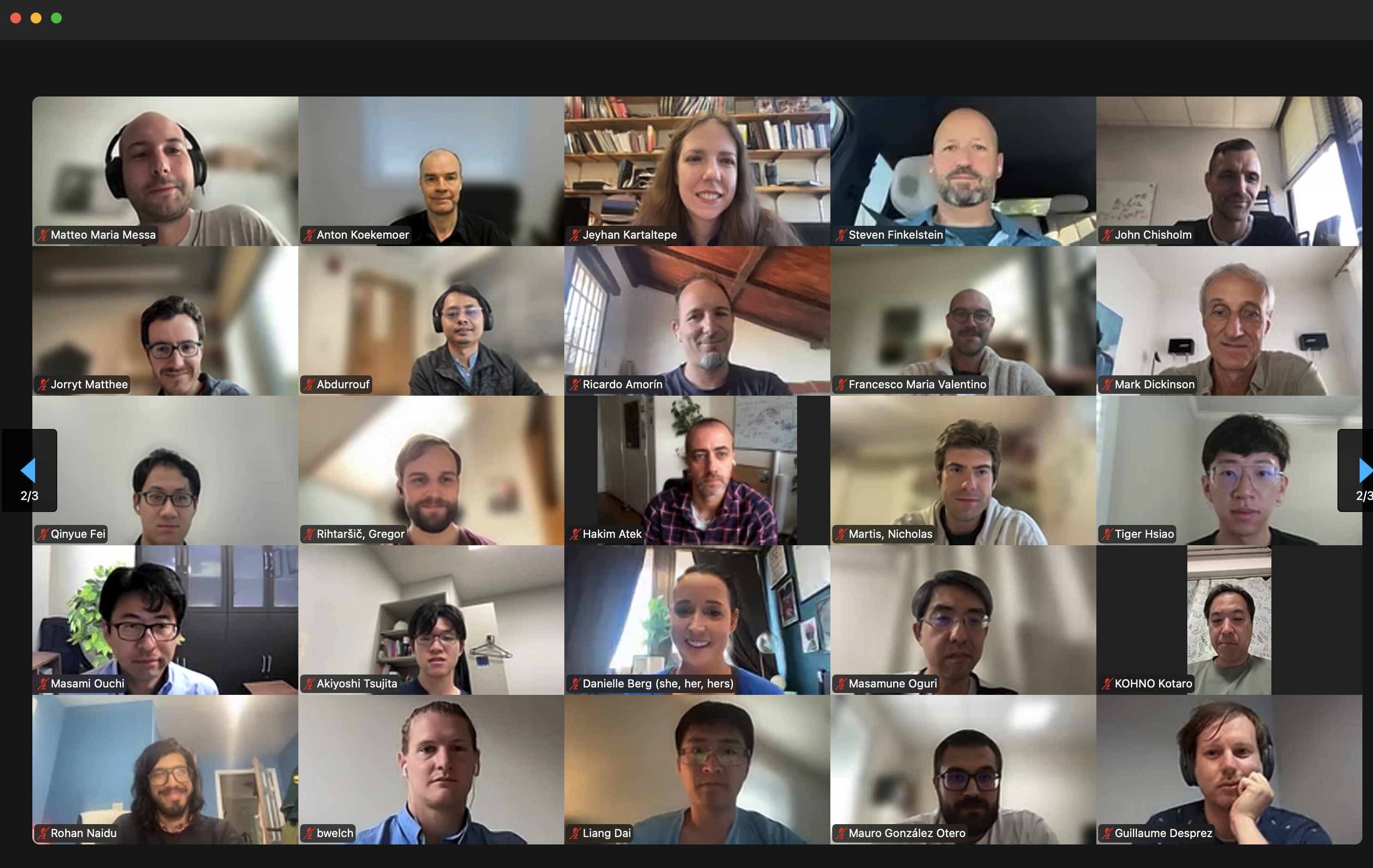
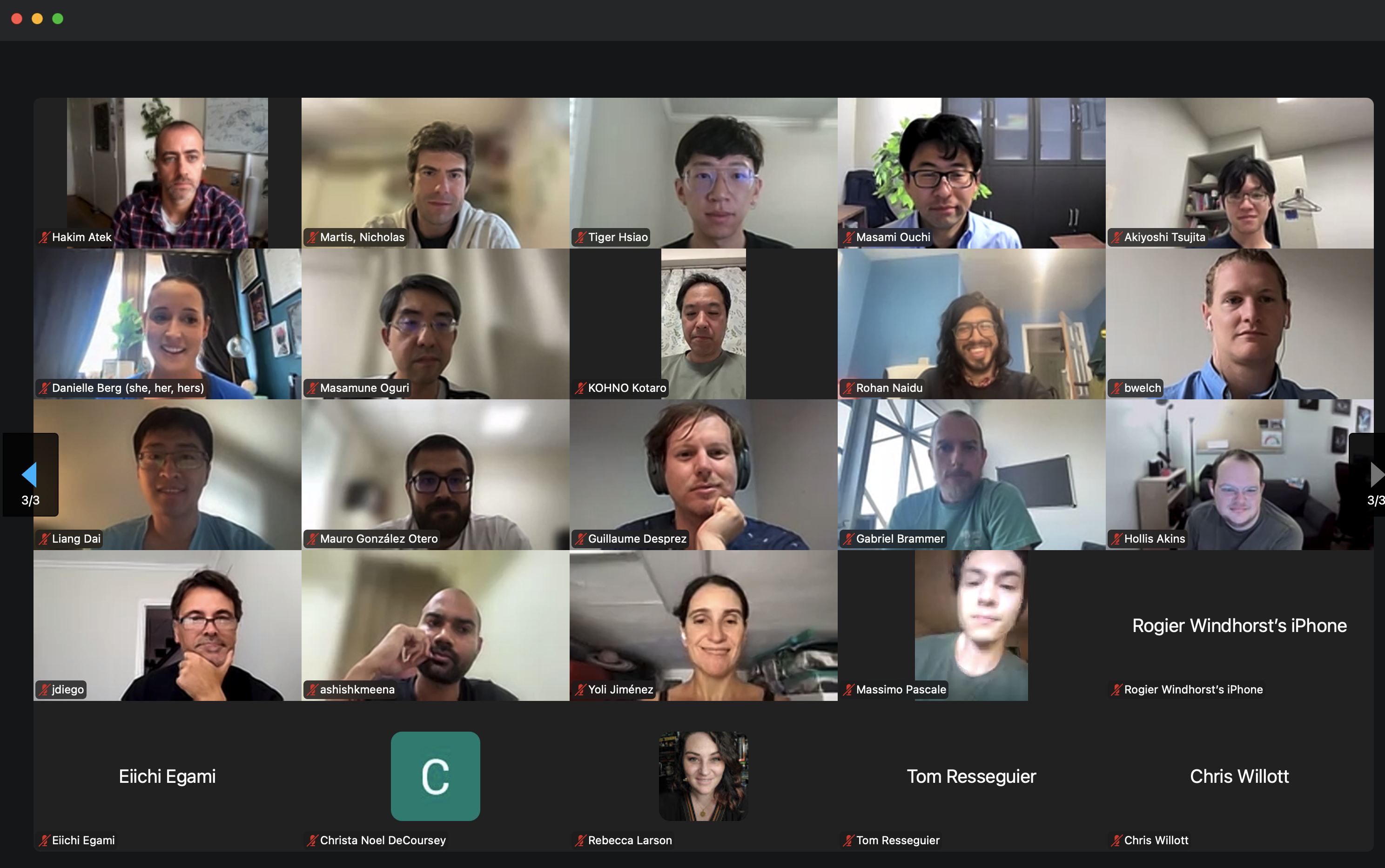
PIs Seiji Fujimoto (U.Toronto) & Dan Coe (STScI),
with 150+ international members from around the world.
Read more about our team here.
The observations are smoothly ongoing and are scheduled to be completed in Summer 2026. The first data release (DR1) is anticipated in late 2026.
Please stay tuned for updates here.
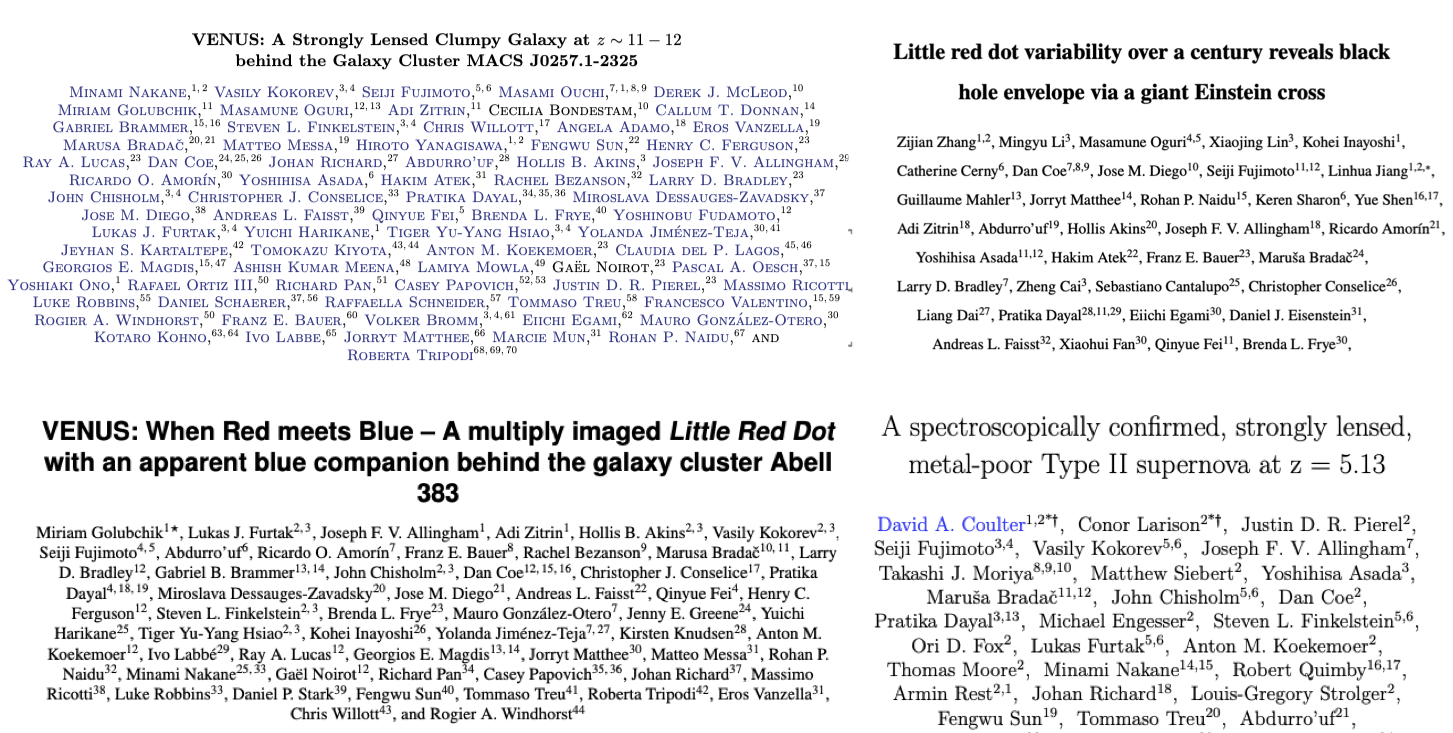
View the full list of VENUS publications on ADS.

Conferences, team meetings, and public events will be announced here.
Support for the VENUS program is provided by NASA through a grant from the Space Telescope Science Institute, which is operated by the Association of Universities for Research in Astronomy, Inc., under NASA contract NAS 5-26555, and by Canadian Space Agency (CSA) under the contract 25JWGO4A18.